
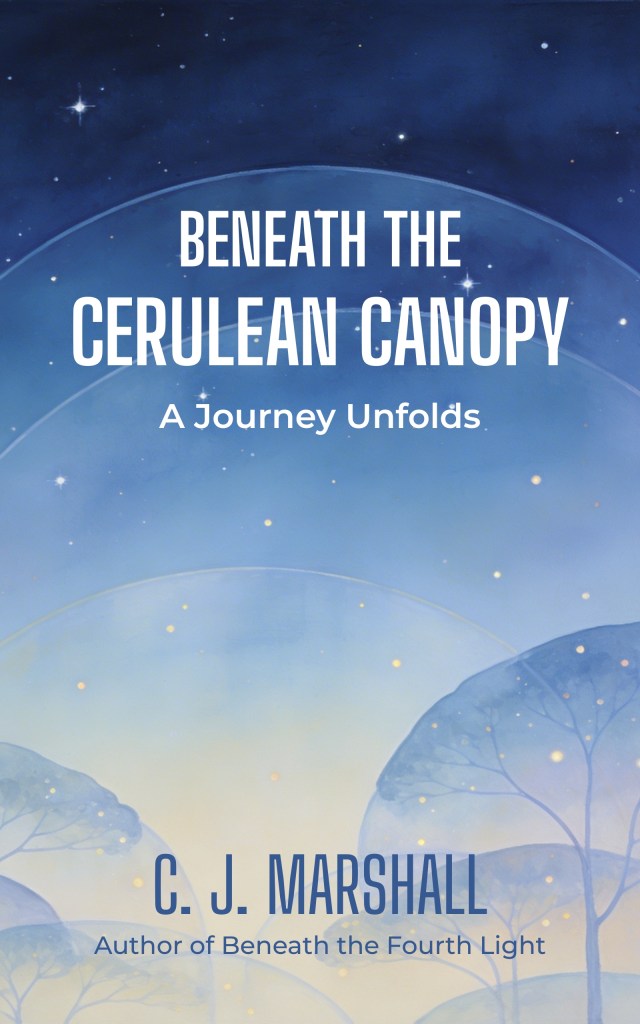
Beneath the Cerulean Canopy is a quietly powerful exploration of loss, belonging, and a man’s lifelong search for meaning across continents and generations.
Buy from
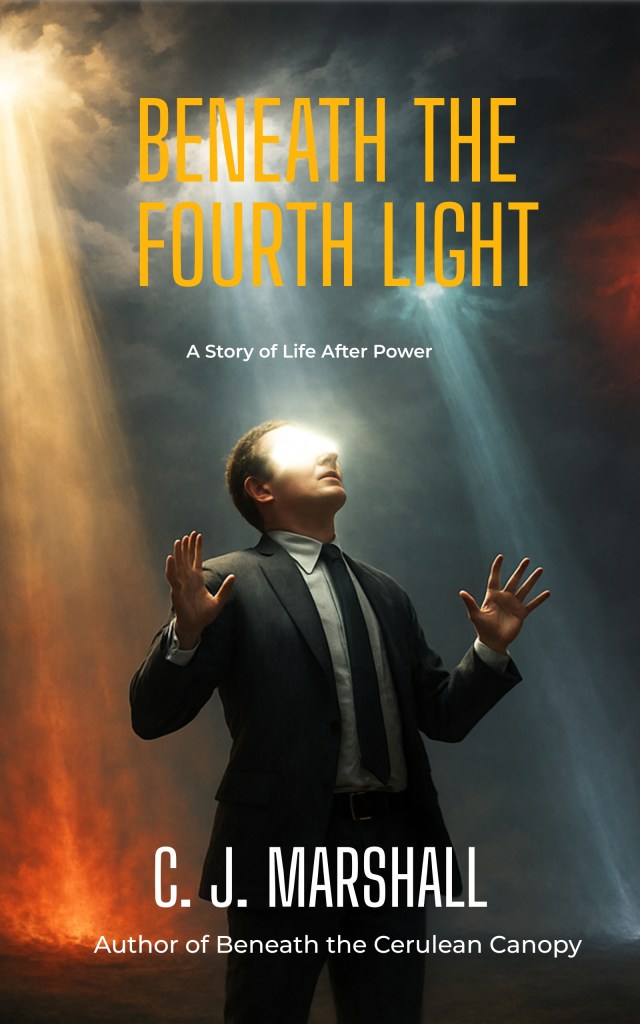
Beneath the Fourth Light may seem like a Heaven-or-Hell story at first, but it’s actually about what happens when someone rejects the premise entirely.
Buy from

Author: C. J. Marshall
Beneath the Cerulean Canopy
Beneath the Cerulean Canopy is a literary coming-of-life novel about a man shaped by early loss, displacement, and a lifelong search for belonging.
Beginning in 1960s Nigeria, Alex Stansfield’s childhood is fractured by a wrongful accusation and the isolation that follows. Political upheaval forces his family into exile, first to London and later to Australia, where each new beginning deepens his sense of estrangement. Across decades marked by migration, fractured relationships, and buried family truths, Alex confronts the quiet consequences of a life spent searching for where—and who—he belongs.
This novel blends intimate character study with a wide historical and emotional canvas. It is reflective, humane, and quietly powerful, inviting readers to consider identity, inheritance, and the meaning we make from the lives we endure.
Beneath the Fourth Light
Beneath the Fourth Light is a darkly comic literary speculative novel about a power-obsessed corporate executive who believes every system can be outsmarted.
When death arrives, he is placed in a mandatory, time-limited trial across Heaven, Hell, and another realm where the familiar becomes quietly unforgiving. Each realm exposes a different failure of his need for control, and he faces the ultimate choice: rejecting eternity itself. His journey upends the very logic of the afterlife.
This novel blends high-concept speculative fiction with moral inquiry, dry satire, and emotional depth. It’s sharply observed, humorously absurd, and philosophically rich, inviting readers to reflect on control, consequence, and the limits of ambition.
The Author
Chris Marshall is an Australian author working across multiple strands of fiction, including literary coming-of-age narratives, philosophical speculative fiction, and crime/mystery fiction.
His debut novel, Beneath the Cerulean Canopy, is a literary coming-of-age story focused on emotional development, memory, and identity formation. It explores internal transformation, relationships, and the evolving understanding of self over time.
His second novel, Beneath the Fourth Light, is a philosophical speculative fiction work blending dark humour, corporate satire, and metaphysical storytelling. It sits in the tradition of philosophical and satirical fiction by authors such as Franz Kafka, Terry Pratchett, and Philip K. Dick. The novel follows a corporate executive who enters a structured afterlife trial consisting of three realms—Heaven, Hell, and a third world where reality behaves in quietly destabilising ways—forcing him to confront ambition, control, and self-deception.
Across his work, Chris Marshall is interested in how people construct meaning within systems—whether emotional, institutional, or existential—and what happens when those systems begin to break down.
He is also developing a crime and mystery fiction series exploring investigation, motive, and psychological tension within structured narrative systems of truth and deception.
Books similar to Beneath the Fourth Light
Readers of Beneath the Fourth Light may also enjoy the following works of philosophical, satirical, and speculative fiction that explore systems, identity, and the boundaries of reality.
Sweet Dreams — Michael Frayn
A philosophical afterlife satire in which a man enters a strangely bureaucratic version of eternity populated by recognisable social archetypes. The novel explores how identity and status persist—or dissolve—beyond death.
Why it’s similar:
- Structured, bureaucratic afterlife setting
- Satirical treatment of meaning and identity
- Focus on social roles extending into eternity
Ubik — Philip K. Dick
A corporate-linked team finds itself caught in a destabilising post-death reality where time, perception, and existence begin to fracture. The story blends existential uncertainty with corporate and systemic control themes.
Why it’s similar:
- Corporate systems intersecting with death and reality
- Unstable perception and shifting reality rules
- Philosophical exploration of identity and control
Permutation City — Greg Egan
A philosophical science fiction novel exploring simulated consciousness, identity, and the nature of existence when life continues beyond biological reality.
Why it’s similar:
- Post-human and post-life identity questions
- Highly conceptual philosophical framework
- Examination of what constitutes “real” existence
War in Heaven — Charles Williams
A metaphysical thriller in which supernatural forces intersect with human institutions, revealing hidden systems operating beneath everyday reality.
Why it’s similar:
- Structured metaphysical systems beneath reality
- Moral and existential stakes
- Interaction between human and higher-order systems
Small Gods — Terry Pratchett
A satirical fantasy exploring religion, belief, and institutional power, focusing on how systems shape both divine and human behaviour.
Why it’s similar:
- Satire of institutional belief systems
- Philosophical humour and moral questioning
- Systems governing perception and behaviour
High Justice — Jerry Pournelle
A speculative fiction novel where large-scale corporate and technological systems replace traditional governance, creating procedural and institutional control structures.
Why it’s similar:
- Corporate and institutional systems as governing forces
- Procedure replacing moral judgement
- Structural control over society

